
Wayanad is known for its coffee, spice plantations, and mist-kissed hills. It’s a place where nature still wears the crown. But tucked away atop the rugged Ambukutty Mala, you’ll find a site that doesn’t just showcase nature’s beauty—it reveals a history so ancient it forces you to question everything you know about South Indian civilization. This is the Edakkal Cave, and it’s not just a tourist spot; it’s a time machine carved from rock.
The Cave That Isn’t a Cave
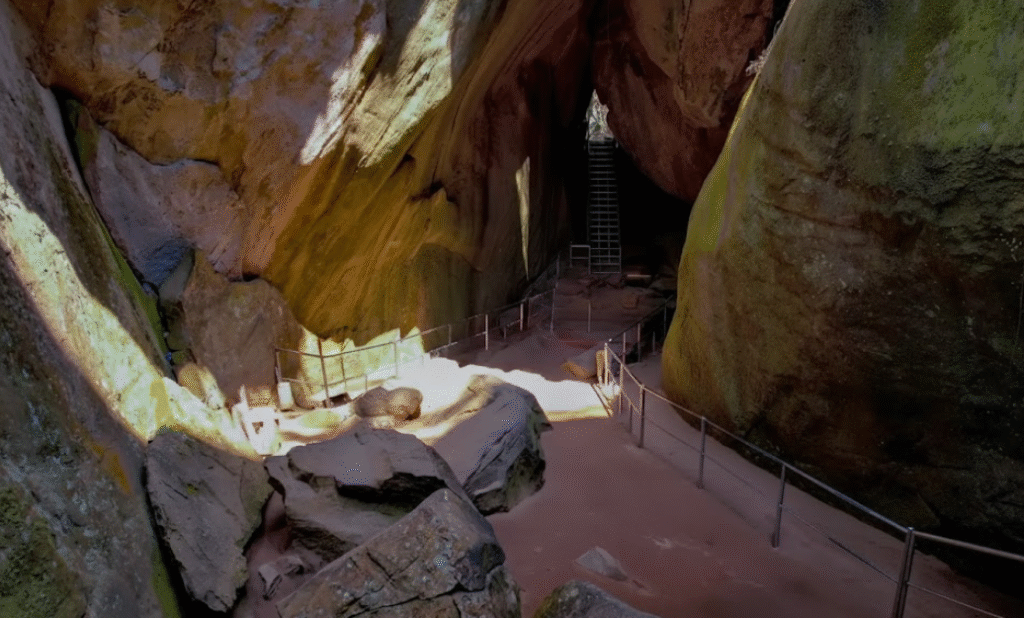
The first paradox of Edakkal is its name. It’s not a cave in the geological sense. The name, which means “a stone in between,” perfectly describes its formation. Imagine a giant’s game of Jenga: a massive, house-sized boulder has fallen and become perfectly wedged between two larger, sheer rock faces. This accident of nature created a spacious, protected rock shelter—a natural canvas ready for the hand of an ancient artist.
The Hand That Drew 8,000 Years Ago
The true magic of Edakkal lies on the walls of this shelter: the petroglyphs. These are not recent inscriptions; they are carvings from the Neolithic era (the New Stone Age), with some dating back as far as 6000 BCE.
Take a moment to let that sink in. These markings predate the great pyramids of Egypt. They are the voices of the very first documented human settlements in the Western Ghats.
As you trace the etchings with your eyes, you see not just crude drawings, but a complex society’s diary:
- Masked Figures: Intriguing humanoids with elaborate headgear, hinting at ritual or social hierarchy.
- Animals: Clear depictions of fauna that roamed the forests of Wayanad millennia ago.
- Symbols and Scripts: Geometric patterns and signs that archaeologists are still struggling to decode.
The Mystery of the Indus Connection
For historians, the greatest puzzle is a single, seemingly insignificant carving: the “man with a jar cup.” This symbol is a distinct motif found in the seals and artifacts of the Indus Valley Civilization, thousands of miles to the north.
What does this one carving mean? Did traders from the Harappan civilization navigate the ancient trade routes down to the Malabar Coast? Does it suggest a cultural link between the highly advanced urban society of the north and the forest dwellers of the south? Edakkal stands as silent, stone-faced proof that Kerala’s history is more interconnected—and far older—than traditional narratives suggest.
The Journey is the Pilgrimage
To truly appreciate the mystery, you must earn the view. The trip begins with a scenic but demanding trek up the Ambukutty Mala. The final ascent involves climbing a series of steep metal steps and navigating narrow rock passages—a physical journey that echoes the passage of time.
When you emerge at the top, you are rewarded twice: first by the humbling presence of the ancient carvings, and second by a truly stunning panoramic view of the emerald valleys and rolling plantations of Wayanad. It’s a moment where history and nature converge, leaving you breathless.
The next time you plan a trip to Wayanad, remember that you are not just booking a relaxing holiday. You are booking an audience with the prehistoric past. Go to Edakkal. Let the whispers in the stone tell you a story that no history book can.